You Can Be Winning at Life and Still Be Losing Where It Matters
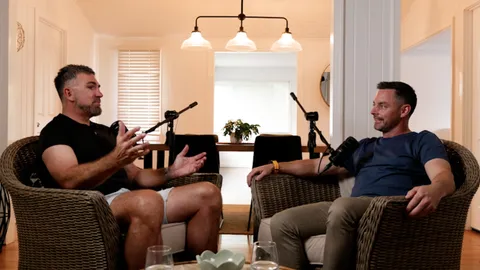
Charlie McCarron reflects on what Olympic gold medallist Duncan Armstrong taught him about competition, friendship and the things success can't fix.

Here's something I've been thinking about. Just because you're successful doesn't mean you've got your shit together. Sometimes success is the very thing that stops you from seeing how much work you've still got to do on yourself.
We admire competitive people. The drive, the discipline, the obsession with winning. Fair enough. It builds businesses and, in Duncan Armstrong's case, wins Olympic gold.
But what happens when that same competitive streak starts costing you friendships, relationships and your own peace of mind? That's where my recent conversation with Duncan got interesting. And pretty bloody uncomfortable.
When winning becomes a problem.
Duncan told me something that genuinely surprised me. He used to find people he admired, become friends with them, and then quietly start competing with them. Once he'd overtaken them, he'd move on.
Think about that. These weren't business competitors. They were his mates. You could dress that up as ambition. Surround yourself with successful people. Keep improving. Never settle.
But let's call it what it is. That's a pretty ordinary way to treat your friends.
To Duncan's credit, he didn't try to justify it. He acknowledged there was more going on. He was avoiding things about himself that he hadn't dealt with. Competition was the distraction. Winning was the escape. Sometimes the very behaviour that gets you applauded professionally is the same behaviour that's damaging you personally.
Successful? Great. But are you actually happy?
Imagine spending most of your life working towards one enormous goal. You sacrifice, train, compete, and eventually win Olympic gold.
Then what?
For Duncan, swimming had given him an identity. A purpose. A reason to get out of bed. And suddenly it was gone. People still wanted to talk about swimming, but he was trying to work out who the hell he was without it. He went on to find success in television and business. Money, recognition, opportunities. All the things we're conditioned to chase… Yet something was missing.
“I was very successful, but I wasn't purposeful.”
That line stuck with me.
How many of us chase the next deal, promotion or financial milestone because we're convinced it'll make everything feel different? And when we get there? It feels fantastic for about five minutes. Then we're looking for the next mountain.
Meanwhile, the things that matter might be falling apart around us. Relationships. Family. Health. The ability to enjoy the life we're supposedly working so hard to build.
Are you genuinely building a better life, or just getting better at avoiding the one you've already got?
The stuff we don't like talking about
This conversation with Duncan became pretty personal for me.
When my son Hamish was born with a significant disability, it knocked me around. Badly. I love that boy more than I could ever put into words. I wouldn't change having him for anything. But I'd be lying if I said I handled everything that came with it particularly well. I didn't.
There were emotions I struggled to understand, things I found difficult to accept, and parts of my own response that I'm not especially proud of. Eventually, I realised I needed some help. Not because there was something wrong with Hamish. Because there were things going on inside me that I needed to sort out.
That's confronting when you're used to fixing problems, making decisions and getting on with things. Duncan and I share something that goes well beyond business or success. We both have sons who are nonverbal.
We could talk about the love, the difficulties and the frustrations without having to pretend any of it was simple. And we came back to an uncomfortable truth. Sometimes the biggest problem isn't what's happening around us. It's how we're responding to it. That applies to parenting, marriage, friendships and pretty much every relationship we have.
You can have the best intentions in the world. But your family doesn't live with your intentions. They live with your behaviour.
Being honest is easy. Until it costs you something.
I asked Duncan what doing the work on yourself actually looks like. His answer was simple. Tell the truth. And surrender the outcome. Sounds easy. Until you have to do it.
What about admitting you got something wrong without immediately explaining why? Apologising without expecting an apology back? Telling someone you care about something they might not want to hear? That's a different kind of honesty, particularly for people who are used to being in control.
I raised a personal situation with Duncan involving someone close to me. We spoke about what it means to support someone when you don't have all the answers. Sometimes you can't fix the problem. You can't make someone see it your way. You can't control the outcome.
You can be honest, listen and let them know you're there.
There's no trophy for that. But it might matter a hell of a lot more than another professional achievement.
Maybe having less to prove is the real win
Towards the end, I asked Duncan how he'd introduce himself if we bumped into each other at the footy. His answer said plenty. He used to swim. Now he's a family man.
An Olympic gold medallist, and the thing he values most today is his family.
He also spoke about the friends his younger self might have overlooked. People who are caring, honest and prepared to call him out. And he admitted something a lot of high achievers hate saying. He needs help every day.
We spend so much time convincing people we've got everything under control. Career's good. Business is good. Family's great.
But is it? Or have we just become really good at telling everyone that?
So what's the takeaway?
I'm not suggesting ambition is a bad thing. I love competing. I love building businesses. I love winning. And I don't intend to stop.
But there's a difference between being successful and being someone you're actually proud of. You can be a brilliant businessperson and a terrible partner. Admired by hundreds and barely present for the handful who matter most.
When someone challenges you, do you listen or immediately get defensive? When a mate gets ahead, are you genuinely happy for them or do you feel the need to go one better? And when things aren't going well at home, are you willing to look at your own part in it?
You can't outperform the stuff you refuse to deal with forever.
Maybe the biggest win isn't another deal or accolade. Maybe it's having a little less to prove, a lot more self awareness, and people who actually enjoy having you around.
That's a version of success worth chasing.
Watch or listen to my full conversation with Duncan Armstrong on Talk To Me with Charlie McCarron. We talk competition, identity, family, parenting and what success can't fix.

About Charlie
Charlie McCarron is Selling Principal at Ray White Rockhampton and host of Talk To Me, where he speaks with high performers about ambition, pressure and the people behind the achievements. For speaking enquiries and 2027 events: https://www.talktomewithcharlie.com/speaking
Watch the full conversation
Hear the full conversation with Duncan Armstrong on your preferred platform.